Read more...
Short-Term Predictions
By Saj Karsan, Friday, April 30, 2010, 6:15 AM | cramer, short-term | 0 comments »Read more...
For What It's Worth
By Saj Karsan, Thursday, April 29, 2010, 6:56 AM | Genesis Land Development | 8 comments »Just over a month ago, we saw that real-estate development company Genesis Land (GDC) hired a 3rd party appraiser to value its land holdings. The signal from management was clear that it believed the market was severely undervaluing its properties. The appraisal results did not disappoint; the company's stock price rose 25% on the day the appraisal results came out.
Read more...
Earnings Persistence
By Saj Karsan, Wednesday, April 28, 2010, 6:53 AM | Cambrex, circle of competence | 0 comments »Value investors love finding stocks trading at low P/E values, as this means the price that must be paid for the stock is low relative to the company's earnings. But the investor cannot assume that current or recent earnings will persist forever, as this could result in an overpayment for a stock. One warning sign in particular that may indicate that earnings may not persist are abnormally high returns on equity.
Read more...
De-registration Opportunities
By Saj Karsan, Tuesday, April 27, 2010, 6:11 AM | Boss Holdings | 2 comments »When a US company announces that it will de-register its shares, it no longer has to file annual and quarterly reports with the SEC. While this can reduce expenses significantly for certain small companies, it is invariably followed by a drop in the company's share price, since the appeal of investing in a company that doesn't have to make such reports is quite low.
Read more...
Before they can make money, companies must make capital investments. But since the future is always uncertain, investments with longer payback periods are often more risky than those with shorter payback periods. This is because the shorter the payback period, the lower the risk that market conditions can render the initial investments obsolete/useless.
Read more...
New Era Value Investing: Chapter 1
By Saj Karsan, Sunday, April 25, 2010, 6:14 AM | New Era Value Investing, Tengler | 0 comments »As the chief investment officer at Fremont Investment Advisors, Nancy Tengler employed the value approach she describes in her book, New Era Value Investing.
Read more...
Freakonomics: Chapter 6
By Saj Karsan, Saturday, April 24, 2010, 6:28 AM | Freakonomics, Levitt | 0 comments »Charlie Munger says the most important rule in management is "Get the incentives right". Munger argues that the power of incentives is constantly underestimated. In Freakonomics, Steven Levitt shows us how pervasive incentives are in society, and what we can learn from that. Value investors who can grasp the power of incentives put themselves in a position to understand which companies are utilizing the full potential of their managements.
Read more...
A rather large percentage of companies experienced declines in revenue in both 2009 and 2008, as the general level of aggregate spending declined in most markets. For most of these companies, these declines can be considered temporary. However, investors must take care not to assume that all firms with revenue declines are experiencing only temporary issues; for some firms, the drops in revenue are part of a secular (rather than cyclical) decline.
Read more...

Read more...
Significant Regulatory Changes
By Saj Karsan, Wednesday, April 21, 2010, 6:32 AM | Chromcraft Revington, regulatory changes | 7 comments »Some regulatory changes make minimal impact on company valuations - at least in the short-term. Other regulatory changes, such as tax rate changes, affect almost all companies equally. But some regulatory changes affect only a small group of companies, and in a big way!
Read more...
It is difficult to judge the market's appetite for risk simply on the basis of the equity markets' price levels, as determining what constitutes "too high" or "too low" a price is challenging. One can compare a market's price to its earnings or its book value, but earnings are a moving target and are subject to large non-recurring costs (even in the aggregate) while the efficiency with which assets and leverage are employed also changes.

Read more...
Read more...
Freakonomics: Chapter 5
By Saj Karsan, Sunday, April 18, 2010, 6:44 AM | Freakonomics, Levitt | 2 comments »Charlie Munger says the most important rule in management is "Get the incentives right". Munger argues that the power of incentives is constantly underestimated. In Freakonomics, Steven Levitt shows us how pervasive incentives are in society, and what we can learn from that. Value investors who can grasp the power of incentives put themselves in a position to understand which companies are utilizing the full potential of their managements.
Read more...
Freakonomics: Chapter 4
By Saj Karsan, Saturday, April 17, 2010, 11:12 PM | Freakonomics, Levitt | 0 comments »Charlie Munger says the most important rule in management is "Get the incentives right". Munger argues that the power of incentives is constantly underestimated. In Freakonomics, Steven Levitt shows us how pervasive incentives are in society, and what we can learn from that. Value investors who can grasp the power of incentives put themselves in a position to understand which companies are utilizing the full potential of their managements.
Read more...
Hanwei Energy (HE) is a Canadian-headquartered company that operates in the industrial pipe business (for oil, gas and water transmission) primarily in Asia. The company trades at about a 30% discount to its net current assets, but has seen its revenue decline as a result of a combination of factors (more competition in one of its major markets, the global recession, transformation of one unit into a joint venture, etc.).
Read more...
ITEX Major Shareholder Interview
By Saj Karsan, Thursday, April 15, 2010, 6:44 AM | David Polonitza, ITEX | 2 comments »Last month, we discussed ITEX Corporation (ITEX) and noted that even though a couple of value investor groups hold significant percentages of the company, management seemed intent on protecting its own interests over those of shareholders. Last week, I had the opportunity to interview David Polonitza of The Polonitza Group, a group of shareholders that owns/controls 13% of ITEX's shares:
"The Polonitza Group consists of a number of ITEX shareholders who believe certain strategic decisions and acquisitions made by the Company in recent years have strayed from the focus of expanding and supporting the company’s #1 asset, its franchisee network. We have made a number of proposals which we believe will improve the long term value of the ITEX Corporation."
How would you characterize your relationship with ITEX’s Board of Directors? Have they been open to input, or do they see you as a threat to their positions? I see they have accepted some of your suggestions, such as authorizing a share repurchase plan...is this because of arm-twisting, or are they genuinely open to incorporating other ideas?
"Based upon communications we have received from members of ITEX’s Board of Directors, they do not seem to be interested in entering into a constructive dialogue with our group."
Do you have contact with the other major outside shareholder of ITEX, value investor Sardar Biglari? Would you say his investor interests are aligned with yours?
"The Polonitza Group has no affiliation with Mr. Biglari or any of his entities but we welcome any suggestions made by ITEX members, franchisees, or other shareholders."
"I cannot comment on ITEX’s stock price or my personal opinion on its value. In general, all shareholders, as part owners of any corporation, should take an interest in how a company operates and is governed."
What are the top 1 or 2 things you would like to see management do that it is not currently doing, or what would you like to see management improve on? Your letter of March 23rd outlines a number of initiatives, but give us THE priority in your opinion.
"ITEX’s number one priority needs to be the success of its franchisee network. This includes ensuring franchisees increase their profitability while having the incentive to expand their operations. Acquisitions or initiatives not aimed at improving or expanding the franchisee network need to be carefully examined. Additionally, we believe that ITEX must do a better job at recruiting new franchisees into the system.
"The current economic environment is one that is beneficial to ITEX’s business model. I refer to a 1992 NY Times article that profiled ITEX and the barter industry during another significant recessionary period in the U.S. The ITEX broker in the story, who is still a franchisee today, stated that when times were good he had difficulties signing up new members, but as the economy declined, he had to turn some businesses away. Like some of ITEX’s competitors, we should be seeing a measurable increase in the overall number of members and transactions taking place within ITEX’s marketplace, but based on publicly available financial information, this is not taking place. We believe that this is in part due to decisions made by the company over the past few years that have resulted in the ITEX Corporation not being able to capitalize on all of its potential opportunities.
"The second priority is to improve ITEX Corporation’s corporate governance. As we detailed in our letter sent to ITEX’s Board, there presently exists outside business relationships between the three directors and their various companies.
"We also feel it is necessary for ITEX to hire a separate CFO in either a full-time or part-time capacity to allow the CEO to focus on his responsibilities while ensuring that the proper internal checks and balances exist.
What do you see as some possible reasons (both negative and positive) that might make you sell your shares?
"I cannot comment on reasons we might buy or sell the stock."
Read more...
Read more...
The following is a guest post from IR GRO:
Last December, Keryx announced the initiation of a Phase 3 pivotal study of Perifosine (KRX-0401), the Company's PI3K/Akt pathway inhibitor (a cell signaling pathway that disrupts the normal cell cycle / programmed cell death and leads to chemotherapy drug resistance in some cancer cells), in multiple myeloma patients under a Special Protocol Assessment (SPA) with the FDA with Fast Track designations for this indication.
Perifosine is in-licensed by Keryx from Aeterna Zentaris. Keryx expects a patient recruitment period of approximately 16-18 months and expects to report data from this study during 2H11. In addition, a refractory metastatic colorectal cancer (mCRC) study under SPA is expected to begin 2Q10 with projected completion 2H11.
During the first week of 2010, Keryx announced that it has reached agreement with the FDA regarding a SPA for the design of a Phase 3 clinical program for Zerenex (ferric citrate), which is the Company's iron-based phosphate binder for the treatment of elevated serum phosphorous levels (hyperphosphatemia occurs in the majority of dialysis patients, resulting in serious medical complications such as blood vessel calcification and skeletal deformities since phosphate is a major component of bone along with calcium) in patients with end-stage renal disease (ESRD) that are on dialysis.
Zerenex works by forming iron-phosphate complexes in the gut that are not absorbed since patients with ESRD are prone to electrolyte disorders such as elevated phosphorus due to the absence of normal kidney function. In accordance with the Company's SPA agreement with the FDA, the Phase 3 clinical program for Zerenex will consist of two clinical studies, including (1) a short-term efficacy study that is expected to commence by the end of 1Q10 with date expected during 2H10; and (2) a long-term safety and efficacy study that is expected to begin mid-2010 with data expected and a NDA filing expected during 1H12.
Keryx has retained all key commercial rights for its two lead compounds and has the resources to complete Phase 3 development for both of its lead compounds, which provides more leverage in partnership discussions. The estimated cash burn rate for 2010 is $1.3 million per month or approximately $4 million per quarter and $16 million for the entire year.
This is a sponsored post placed by IR GRO on behalf of ProActive Capital. Please visit the ProActive News Room for more details on Keryx.
Read more...
Avoiding Stock Market Scams
By Saj Karsan, Tuesday, April 13, 2010, 6:10 AM | NewMarket Technology, Stock Market Scams | 7 comments »We have discussed a couple of companies on this site that don't trade on the major exchanges (e.g. the NYSE, the Nasdaq etc). Though it has been mentioned that over-the-counter stocks do not offer investors the same protections as do stocks trading on the exchanges, the details were not explored. However, there are some "smell tests" investors may wish to apply to such apparent opportunities.
Read more...
Mirant (MIR) produces and sells electricity in specific markets within the US. It trades at its lowest price in several years, and currently has a P/E of just 3 and a P/B of just .35! It has almost as much cash as it does debt, despite operating in an industry where higher debt loads are considered safe.
Read more...
Freakonomics: Chapter 3
By Saj Karsan, Sunday, April 11, 2010, 6:02 AM | Freakonomics, Levitt | 0 comments »Charlie Munger says the most important rule in management is "Get the incentives right". Munger argues that the power of incentives is constantly underestimated. In Freakonomics, Steven Levitt shows us how pervasive incentives are in society, and what we can learn from that. Value investors who can grasp the power of incentives put themselves in a position to understand which companies are utilizing the full potential of their managements.
Read more...
Freakonomics: Chapter 2
By Saj Karsan, Saturday, April 10, 2010, 6:08 AM | Freakonomics, Levitt | 0 comments »Charlie Munger says the most important rule in management is "Get the incentives right". Munger argues that the power of incentives is constantly underestimated. In Freakonomics, Steven Levitt shows us how pervasive incentives are in society, and what we can learn from that. Value investors who can grasp the power of incentives put themselves in a position to understand which companies are utilizing the full potential of their managements.
Read more...
Karsan Value Funds: 2010 Q1 Results
By Saj Karsan, Friday, April 9, 2010, 6:08 AM | KVF | 3 comments »Karsan Value Funds (KVF) is a value-oriented fund, as described here. Due to securities regulations, the fund is not open to the public at this time. Should that change in the future, there will be an announcement on this site.
Read more...
In previous posts, we've discussed how forecasts are rarely accurate, and are better at telling us what has happened rather than what is going to happen. So why then do we continue to "consume" forecasts, growing a market for those who continually churn out mountains of useless forecasts?
Read more...
Vicon Industries (VII) sells video surveillance equipment. The company trades for just $23 million, but has cash of $15 million, current assets of $36 million, no debt, and total liabilities of just $9 million. In addition, the company owns a couple of buildings (one in NY State, and one in England), which are carried on the books for over $6 million. As such, from an asset point of view, the stock looks compelling. But the earnings picture is not so clear.
Read more...
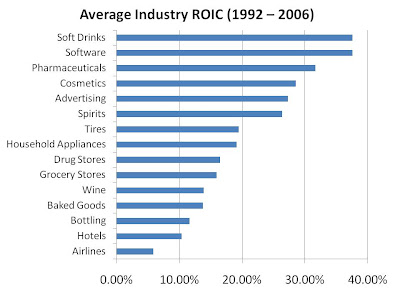
One of the most important determinants of whether a company makes for a good long-term investment is the industry within which it operates. We've discussed the boom and bust nature of the housing industry, the generous margins garnered by the soft-drink industry giants, and reasons why airlines make for poor long-term investments. But on the average, what do industry returns look like?

Read more...
Belzberg's Beelzebub Treatment
By Saj Karsan, Monday, April 5, 2010, 6:17 AM | Belzberg Technologies | 6 comments »Belzberg Technologies (BLZ) provides technology-based brokerage services to institutions and hedge funds in Canada and the United States. This is a highly cyclical business, as seen from the chart below depicting Belzberg's sales over the business cycle:
Read more...
Freakonomics: Chapter 1
By Saj Karsan, Sunday, April 4, 2010, 6:17 AM | Freakonomics, Levitt | 0 comments »Charlie Munger says the most important rule in management is "Get the incentives right". Munger argues that the power of incentives is constantly underestimated. In Freakonomics, Steven Levitt shows us how pervasive incentives are in society, and what we can learn from that. Value investors who can grasp the power of incentives put themselves in a position to understand which companies are utilizing the full potential of their managements.
Read more...
Freakonomics: Introduction
By Saj Karsan, Saturday, April 3, 2010, 6:03 AM | Freakonomics, Steven Levitt | 0 comments »Charlie Munger says the most important rule in management is "Get the incentives right". Munger argues that the power of incentives is constantly underestimated. In Freakonomics, Steven Levitt shows us how pervasive incentives are in society, and what we can learn from that. Value investors who can grasp the power of incentives put themselves in a position to understand which companies are utilizing the full potential of their managements.
Read more...
Influence: Chapter 8
By Saj Karsan, Friday, April 2, 2010, 6:39 AM | Influence, Robert Cialdini | 5 comments »Value investors believe that Mr. Market's mood swings offer them excellent opportunities to buy low and sell high. But how does an investor avoid becoming Mr. Market rather than taking advantage of him? Influence, by Robert Cialdini, helps us understand the factors that influence us, which are exploited by, among others, the news media, our brokers, and research analysts, and thereby puts us in a position to protect ourselves from our own, hard-coded biases that we wouldn't otherwise know have been triggered.
Read more...
In a previous post, we saw how humans have an overconfidence bias, and how that can play havoc on financial forecast estimations. What is not immediately clear, however, is the increasing role overconfidence plays the more knowledge one acquires. That is, as expertise rises, so does overconfidence, resulting in the fact that the people with the most knowledge are likely to be the most miscalibrated, which can result in detrimental effects.
Read more...