Wednesday, April 7, 2010

Vicon Industries

Vicon Industries (VII) sells video surveillance equipment. The company trades for just $23 million, but has cash of $15 million, current assets of $36 million, no debt, and total liabilities of just $9 million. In addition, the company owns a couple of buildings (one in NY State, and one in England), which are carried on the books for over $6 million. As such, from an asset point of view, the stock looks compelling. But the earnings picture is not so clear.

The last business cycle was not kind to this company. Vicon appears to operate in an extremely competitive industry, as there are constant downward pricing pressures that result in tiny or negative margins. A large chunk of revenues must be spent on R&D just to keep up with the competition, some of which are several times larger than Vicon.

The company derives much of its revenues from installations in newly completed buildings and renovations, which makes Vicon's business cycle lag that of the general economy. (Since recently completed buildings still need security during recessions, the company had been profitable up until the last quarter. But since few building/renovation projects are started during recessions, Vicon sees its revenues drop a few quarters later, when those buildings would have been completed.)

As such, the company hit a wall in the last calendar quarter of 2009, as the lack of newly completed buildings/renovations finally caught up to the company: sales (year-over-year) were down almost 30% to $11 million. However, the company's situation is not as poor as the sales record would indicate. While the company's sales were just $11 million, it recorded orders (i.e. future revenue, likely) of over $13 million for the 2nd straight quarter.

The company appears willing to use its cash reserves to prop up its share price, as the company has been buying back shares at a decent rate, with plans to continue to do so. An important caveat, however, is a pending lawsuit on the company for patent infringement; to its credit, the company has been successfully defending itself, but the plaintiff continues to escalate its appeals.

The stock does have a margin of safety from an asset point of view. But both the long-term and short-term earnings situations are murky (thanks to the competition and the cyclical situation, respectively), making this a tough decision for value investors!

Disclosure: None

Tuesday, April 6, 2010

Considering The Industry

One of the most important determinants of whether a company makes for a good long-term investment is the industry within which it operates. We've discussed the boom and bust nature of the housing industry, the generous margins garnered by the soft-drink industry giants, and reasons why airlines make for poor long-term investments. But on the average, what do industry returns look like?

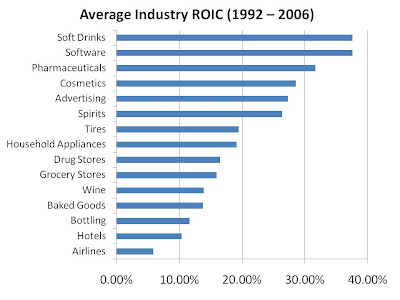
Harvard Professor Michael Porter, using data from Standard and Poor's as well as Compustat, has calculated the profitabilites of various industries over the 1992-2006 period, some of which are shown below:

Clearly, there is high variability in returns on capital by industry. Average industry ROIC in the US was calculated at 14.9% by Porter, demonstrating that some industries are clearly extremely profitable, while others destroy capital.

Does this mean you shouldn't own a company whose industry returns fall below the average ROIC? Absolutely not! Within industries, returns may also be highly variable, in the case where one or two companies have differentiated themselves or are low-cost producers that generate consistent industry-beating returns. Furthermore, even companies with meager returns can trade at such large discounts to book that returns on the market price of equity are quite high. But you may still want to stay away from the airline industry!

Monday, April 5, 2010

Belzberg's Beelzebub Treatment

Belzberg Technologies (BLZ) provides technology-based brokerage services to institutions and hedge funds in Canada and the United States. This is a highly cyclical business, as seen from the chart below depicting Belzberg's sales over the business cycle:

Consider the magnitude of the year-to-year revenue increases/decreases! As such, when revenues decline, the company will most certainly lose money until it can lower its costs accordingly. Operating profits for Belzberg continue to be negative, as the company is still scrambling to cut its costs in line with this new revenue environment.

But due to the nosedive in the company's revenue and operating margin, the company's stock price may have overreacted. While Belzberg trades for just $8 million, it has $20 million of cash against just $8 million of total liabilities. In addition, the company has a few million dollars of current receivables, sweetening up the offer for potential shareholders.

With such a large margin of safety and no debt against it, the company can continue to lose money for a few quarters before shareholders risk losing capital. However, to see large stock price gains, extraordinary sales or profit growth isn't necessary. If management can cut expenses to the point where the company is at a break even level, shareholders at this price are likely to be rewarded. To that end, the company has announced layoffs and freezes that should help in this regard.

However, the company does have some fixed costs which are likely to be difficult to cut. If these poor revenue conditions continue for several quarters, a merger with a company with similar costs may be the only way to profitability. The current margin of safety on the company's stock may allow shareholders to benefit from either of these options.

Disclosure: Author has a long position in shares of BLZ

Sunday, April 4, 2010

Freakonomics: Chapter 1

Charlie Munger says the most important rule in management is "Get the incentives right". Munger argues that the power of incentives is constantly underestimated. In Freakonomics, Steven Levitt shows us how pervasive incentives are in society, and what we can learn from that. Value investors who can grasp the power of incentives put themselves in a position to understand which companies are utilizing the full potential of their managements.

It is not easy to design incentive schemes, because the underlying behaviour such schemes encourage are more complex than they originally appear. Levitt argues that there are three types of incentives: economic, social, and moral. A scheme designed to provide an economic incentive can often cause havoc with the social and moral incentives, resulting in a surprising outcome.

Consider an experiment done at a daycare where parents would often pick up their children late. A small fine was instituted in order to discourage late pick-ups. The daycare expected on-time pickups to rise, but instead, the opposite happened, and late pick-ups soared! Levitt argues that this is because the economic incentive did not compare to the counteracting moral incentive that was now removed: with the fine, parents were implicitly told that it was okay to pick up their children late, as long as they paid the fine. When the fine was removed, late pick-ups did not drop back to their original levels. Now, parents no longer felt guilty about late pick-ups, as the moral incentive had been removed.

Would a larger fine have caused the economic incentive to be larger than the moral one it failed to substitute? Perhaps, but economic incentives that are too strong often have other unintended effects.

Cheating is an economic act: getting more for less. Levitt discusses a few examples where cheating has occurred because the economic incentives were so strong. He discusses data grabbed from school boards that appears to show teachers were actually changing student responses on standardized tests, as teachers whose students performed well were often awarded large bonuses.

Would massive option and bonus payments cause Wall Street executives to cheat? Obviously, we all respond to incentives, both negative and positive. If you touch a hot stove, you get burned. If you speed, you receive a fine. These are just two examples of every day occurrences that shape our behaviour as a result of the pain or rewards we receive in response to an act we commit. But sometimes incentives are so complex that they can result in unintended behaviour (including cheating, and a removal of other incentives) that can offset the intended benefits!

Saturday, April 3, 2010

Freakonomics: Introduction

Charlie Munger says the most important rule in management is "Get the incentives right". Munger argues that the power of incentives is constantly underestimated. In Freakonomics, Steven Levitt shows us how pervasive incentives are in society, and what we can learn from that. Value investors who can grasp the power of incentives put themselves in a position to understand which companies are utilizing the full potential of their managements.

While the tools of economics are often applied to understand data about jobs, real estate, banking and investment, economics is a science of measurement that can be applied to a range of other subjects. This book uses these economic tools to break down a wide variety of interesting topics, and is based on the following fundamental ideas:

1) Incentives are the cornerstone of modern life
2) The conventional wisdom is often wrong
3) Dramatic effects often have distant, even subtle, causes
4) Experts use their informational advantage to serve their own agenda
5) Knowing what to measure and how to measure it makes a complicated world much less so

To demonstrate these ideas in action, Levitt takes the reader through a few quick examples in the introduction. First, he discusses the crime wave in the United States of the early 1990s. Crime was on the rise, and all the experts were saying that it would continue to do so, for various reasons. Instead, crime - of all types - started to drop in dramatic fashion, and once again the "experts" had their explanatory, after-the-fact opinions (perhaps much like the media attempts to explain daily stock price movements). But Levitt argues that they all missed the boat. Instead, he argues that the legalization of abortion in 1973 (which occurred during Roe vs Wade) is the biggest reason that crime started to drop in the mid-1990s and continued to do so. Many of the people who were most likely to commit crimes (those born of poor, unmarried, teenage mothers) were not born!

Secondly, those who believe a real estate agent is on their side are sorely mistaken. On the surface, it seems as though an agent's incentives are aligned with those of a prospective seller. After all, the realtor's final commission is tied to selling price. Levitt demonstrates, however, that after expenses and sharing commissions and kicking up fees to the company, a real-estate agent doesn't make a whole lot for incremental increases in price. For example, on a $300K house, the seller would get $9400 for a 3% increase in price, but the agent's additional share is just $150. As a result, an agent just wants to get a deal done as quickly and effortlessly as possible, rather than put in a whole bunch of extra time and work to get the seller the best possible price.

Are real-estate agents simply a special breed of sleazy slime balls? Not really, as Levitt argues this type of thing is common to all professionals, including doctors, lawyers, auto mechanics, plumbers etc. The difference, though, is that real-estate data is abundantly available, and so it is easy to demonstrate this phenomenon with this particular group. Levitt separated real-estate data into two groups: in the first, the agents were selling their own homes, while in the second, they were selling other people's homes. Levitt found that agents left their own homes on the market for 10 days longer, and sold them for an extra 3% (all other factors equal).

Finally, Levitt tackles the issue of money and politics. While most people believe elections can be bought, Levitt argues that the data just doesn't support this. The winning party does spend more money than the losing party, but many confuse the cause-and-effect of this relationship (like the czar who heard that the most diseased region of his country had the most doctors...and subsequently ordered all doctors killed). Most campaign donors want to support a winner, which is why the winner spends the most money. To show this, Levitt looked at campaigns where the same two candidates went head to head and different amounts of money were spent. Levitt found that halving ones campaign spend resulted in only a 1 point drop in final performance.

Friday, April 2, 2010

Influence: Chapter 8

Value investors believe that Mr. Market's mood swings offer them excellent opportunities to buy low and sell high. But how does an investor avoid becoming Mr. Market rather than taking advantage of him? Influence, by Robert Cialdini, helps us understand the factors that influence us, which are exploited by, among others, the news media, our brokers, and research analysts, and thereby puts us in a position to protect ourselves from our own, hard-coded biases that we wouldn't otherwise know have been triggered.

In this the final chapter, Cialdini reminds us of how important it is to recognize the shortcuts we employ in the making of decisions, as described in the previous seven chapters. He argues that as the amount of information which is at our fingertips continues to grow (thanks in large part to the internet), humans will increasingly need to use the cognitive tools we have developed to make decisions.

These shortcuts are useful. Without them, we would need to analyze every detail of every situation, often duplicating the work of others or even ourselves. But their use also makes us vulnerable to error. Compliance practitioners who understand these shortcuts can use them against us.

Cialdini urges readers to be aggressive against such practitioners. We should shun products that use such tactics in their advertisements, and send letters to the ad agencies demanding honesty in their marketing. He also advises that we refuse to watch tv programs that use canned laughter, refuse to tip bartenders that we see filling up their own tip jar, and shun night clubs with line ups that offer false evidence of the club's popularity. Boycott, threaten, confront, and censure, in order to retaliate. It's the only way to ensure that these shortcuts remain useful.

Thursday, April 1, 2010

Calibration

In a previous post, we saw how humans have an overconfidence bias, and how that can play havoc on financial forecast estimations. What is not immediately clear, however, is the increasing role overconfidence plays the more knowledge one acquires. That is, as expertise rises, so does overconfidence, resulting in the fact that the people with the most knowledge are likely to be the most miscalibrated, which can result in detrimental effects.

But knowledge alone does not doom someone into being overconfident. James Montier argues that it's a lack of feedback that pushes people to be overconfident. To demonstrate this, Montier cites a study performed by Scott Plous that compares the calibration of weathermen against that of doctors. Weathermen were asked to predict the weather, while doctors were asked to diagnose patients (based on case notes). Both were asked to provide confidence intervals, so that their calibrations could be measured.

Interestingly, weatherman were well calibrated, while doctors were very poorly calibrated. Montier argues that this is because weather forecasters benefit from the fact that they receive immediate evidence of their abilities as forecasters, while doctors do not.

While one may be inclined to believe that financial analysts should be like weathermen in that they can see whether their forecasts came true, similar calibration tests appear to show that analysts are calibrated to a similar extent as doctors! As a result, the industry is glowing with overconfidence. Further testing confirmed the opening hypothesis: experts in finance are more overconfident than lay people, as they apply too narrow a band around their estimates as compared to the general public.